Fiona and I have now opened the first books in our collaboration, there have been plenty of smiles and appreciation of each others work and intense interest in our individual interpretations of the title. The diversity of the two books is a joy and demonstrates the wide spectrum within the definition of the term ‘Artists’ Books’
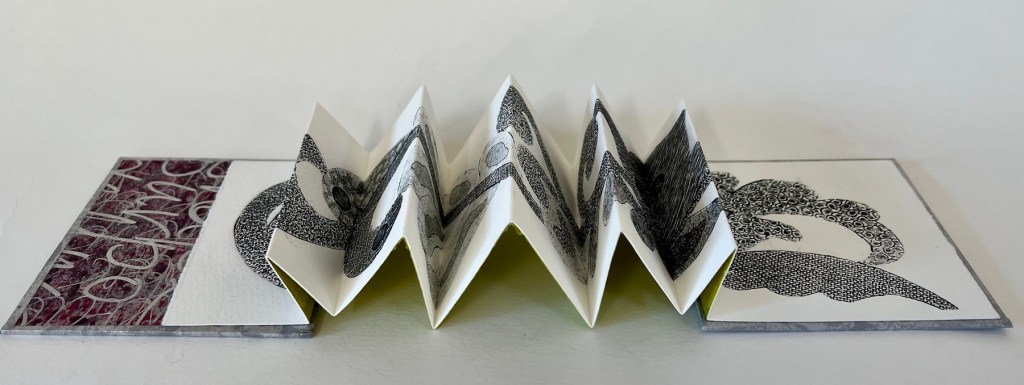
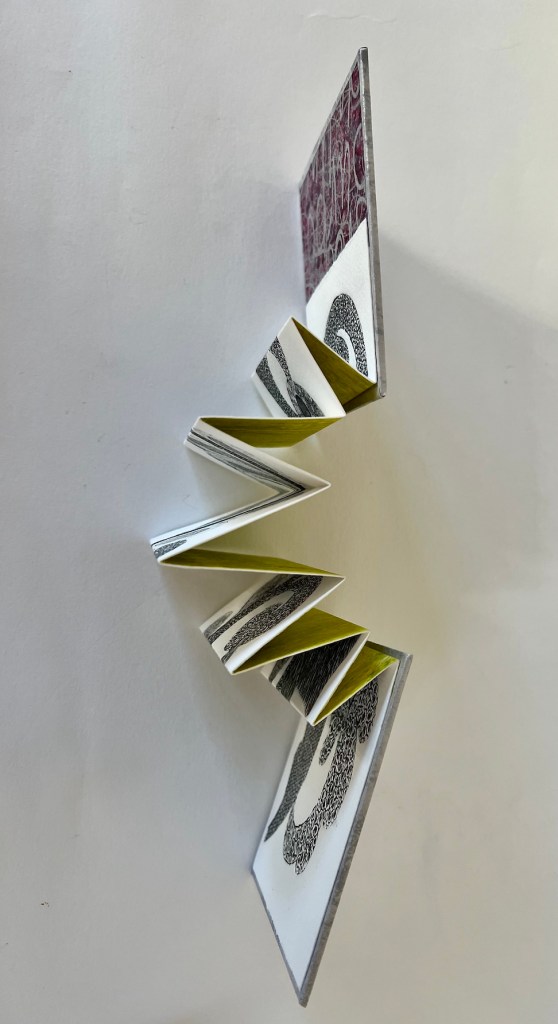
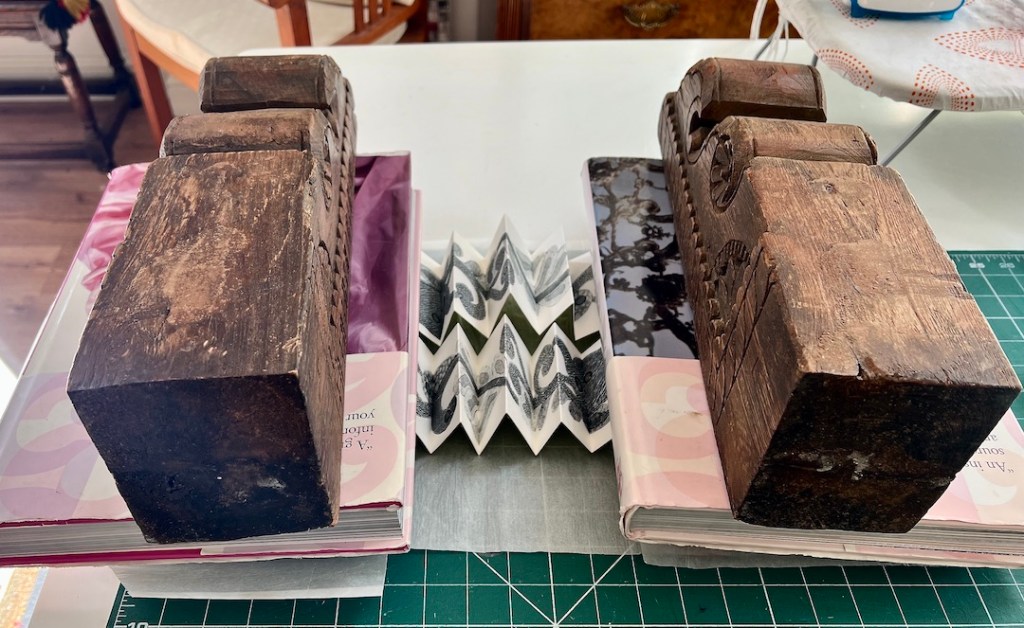
Although I had used a similar format before, this book has a different arrangement of folds, the idea sprang from laying out some of my textiles to photograph, the lace lies flat on the table with a series of folds which gives it life. In many ways this first book was a way of working my way into the project. See here
The needle lace dates from 1680’s, it is English and made from fine linen thread. I designed a plate, inspired by the lace, the same length as the lace, 50cm.
The paper is Somerset 250 gsm
Size 9.5cm high by 50cm
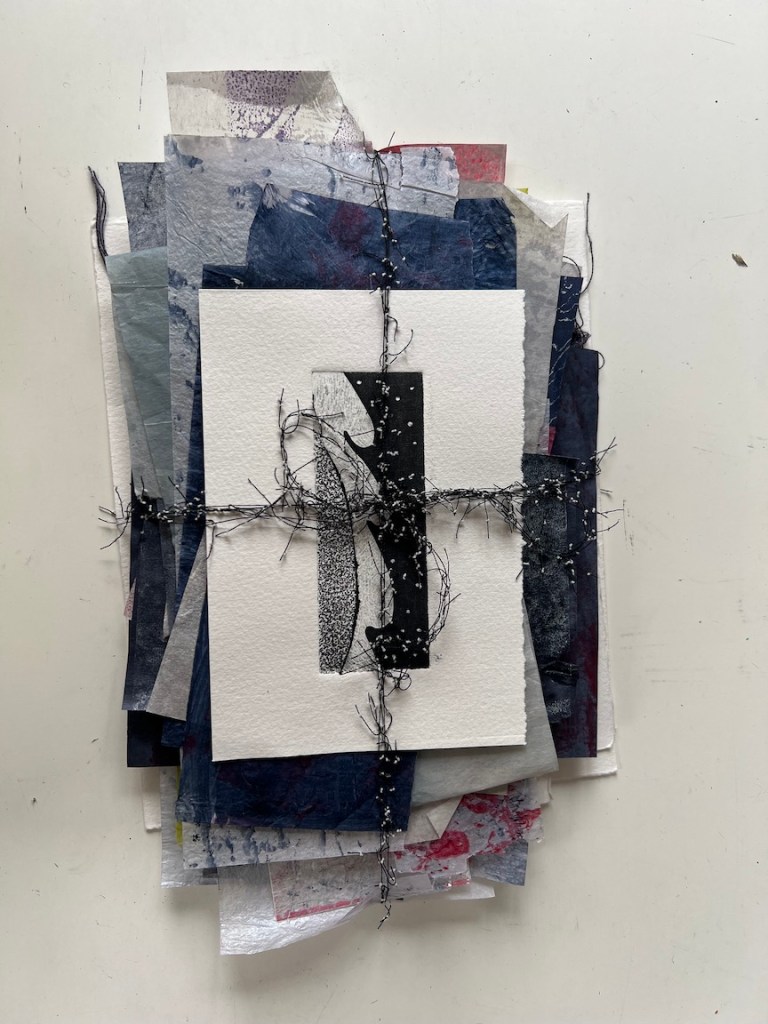
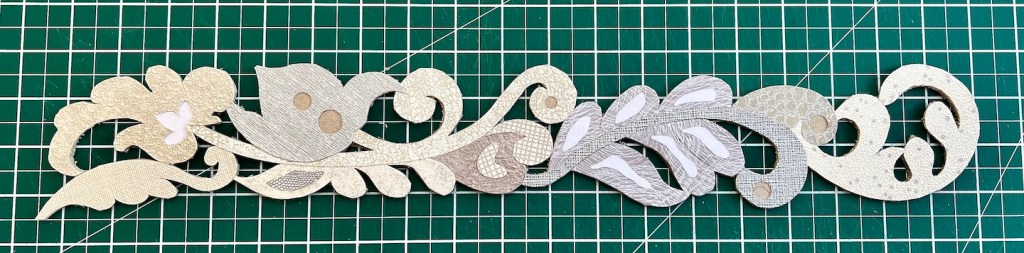
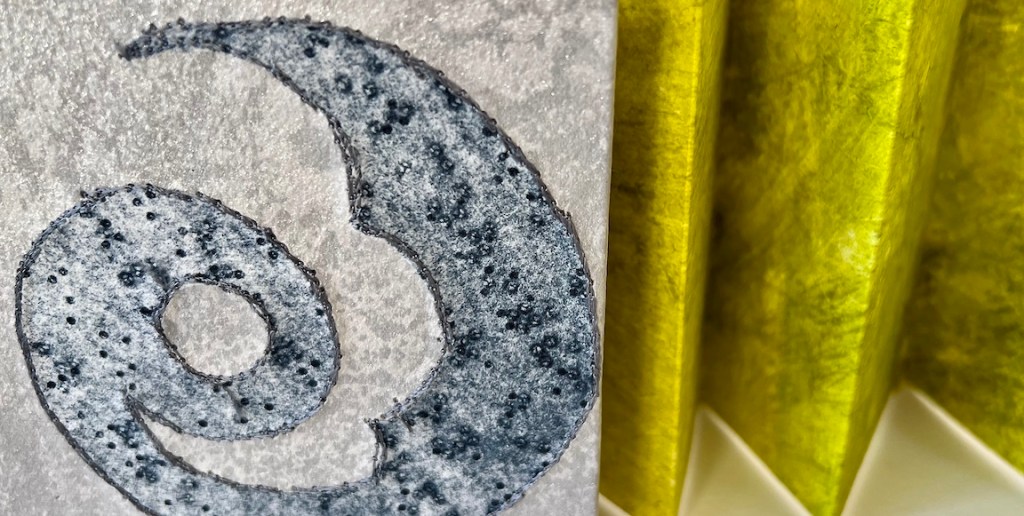
Cover is painted and mono printed paper with an appliquéd printed machine stitched Baroque motif made from a Braille paper print
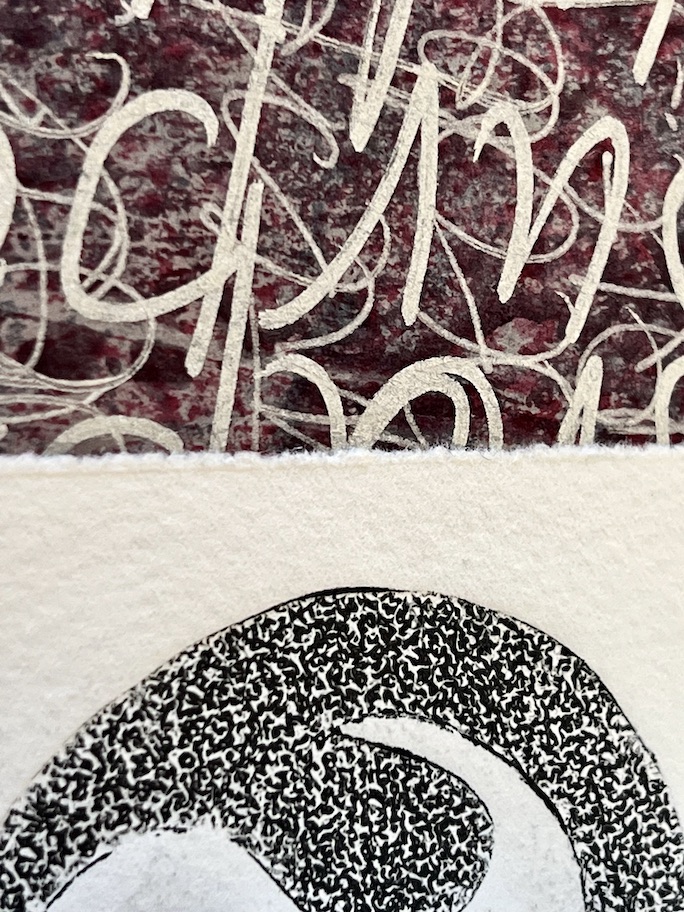
End paper is Japanese paper, from Fiona, which I had painted and with the text of the title written through it.
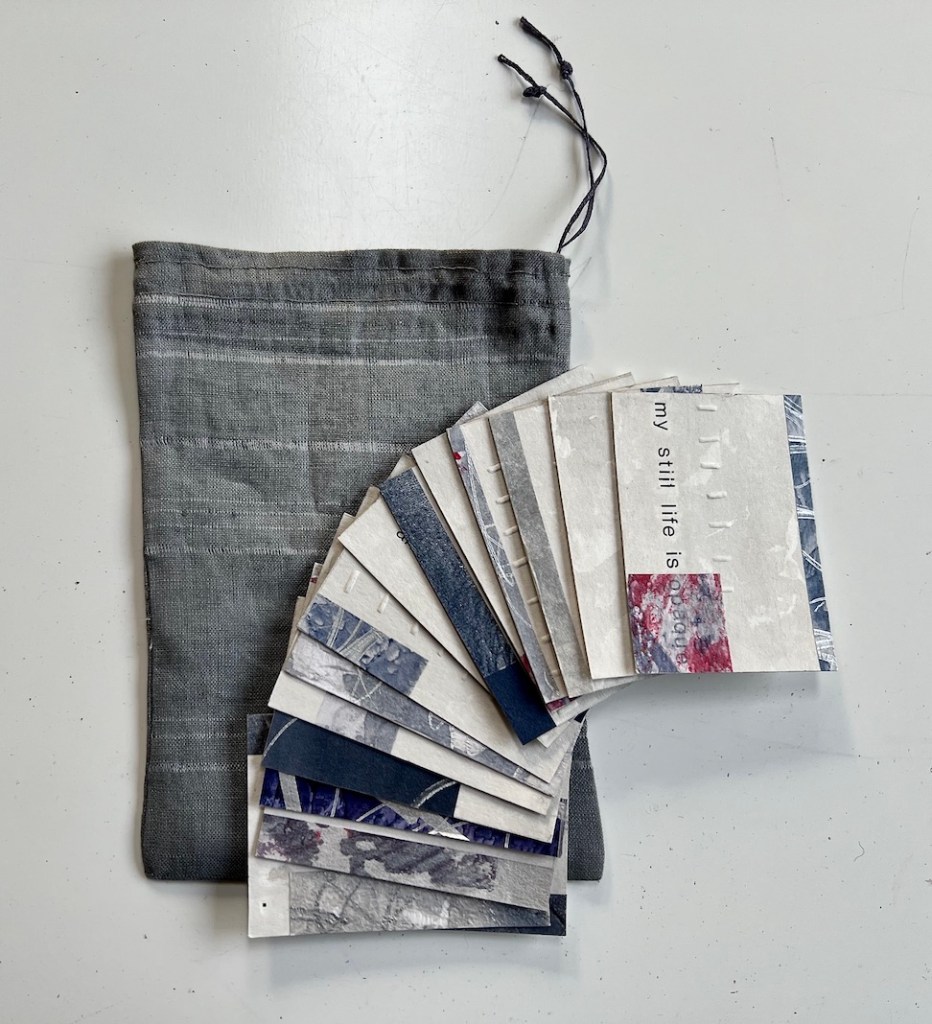
Here is the book from Fiona which I am sure she will write about to explain fully the ideas and processes that she went through. I have explored the different arrangements of the cards, reading the text in different ways and popping the cards back into their linen bag.
An interesting beginning to working together across the miles.
Whilst my book is winging its way to Australia and Fiona’s book is coming this way, my mind turned to other projects which had been roaming around in my head.
During consideration of ‘Shape’, I had worked out this configuration of small concertinas, by stitching them together I was able to form a long and complex book. By joining small concertinas together it was also possible to conquer the restrictive length of a print, in my case 75cm. This book measures almost 1.5metres.
I decided that I would make three books, all to be contained in a slip case.
I needed three plates, two I made and one I already had, these would be the backgrounds
Each plate needed to have the means to place small fragments into the design
And three plates for the small fragments.
Here all the components are laid out.
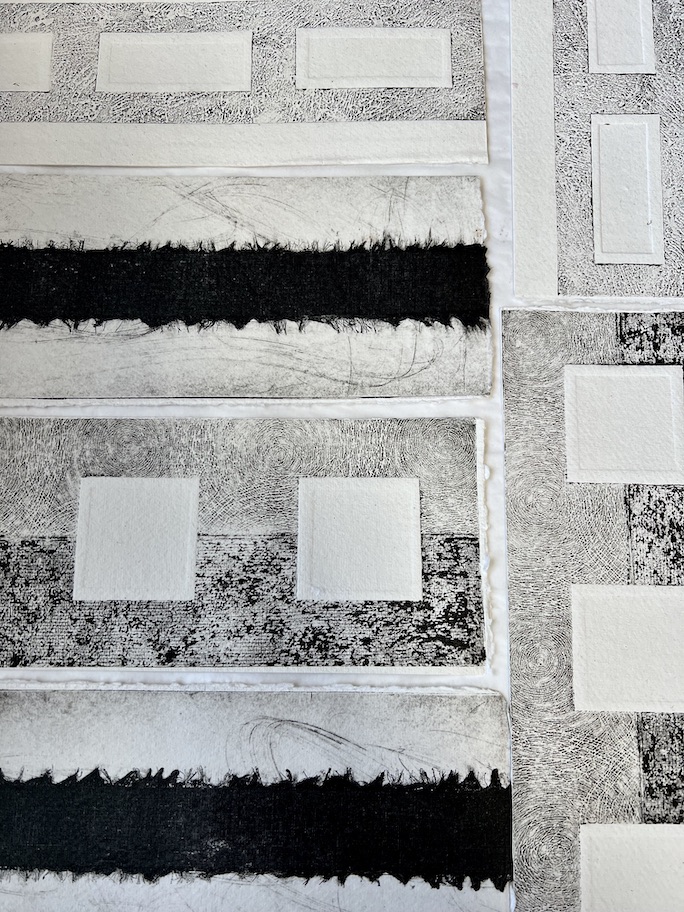
The first printing session involved printing 12 prints
The second session I printed about 100 small fragments of three different sizes, each shape from the same printing plate. For scale the largest fragment is 3cm square.
They are all now drying flat in the house where it is warmer. It will be a couple of weeks before I will be able to fold and stitch them together.
We had been emailing each other for a few years but we have never met, Fiona living in Australia and myself in England. It was interesting considering titles and protocols via the internet and with someone that you don’t know, all those hand and eye movements when you are face to face and the nuances of language aren’t there to gauge the impact of ideas.
With only a little debate we decided that the title would be ‘The Shape of Things’, we would produce editions of two, one for each of us and to consider different structures of books and to include text. We wanted challenges both intellectual and constructional. The first books would begin to be posted off to each other in January 2023 and then at the beginning of each following month. There was no set number.
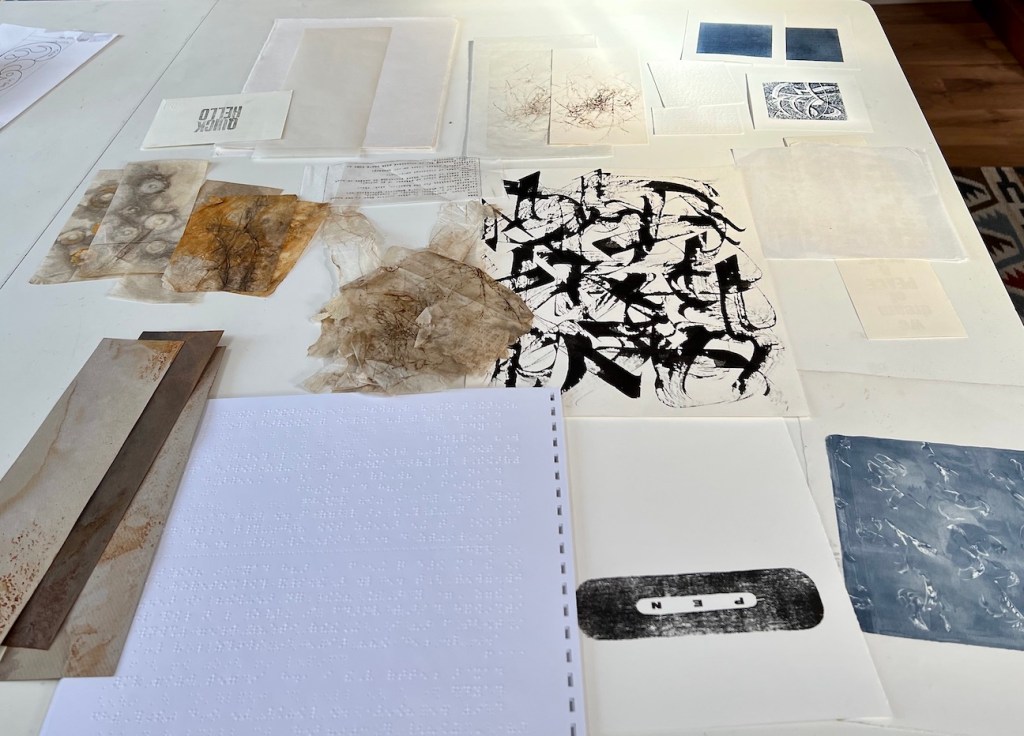
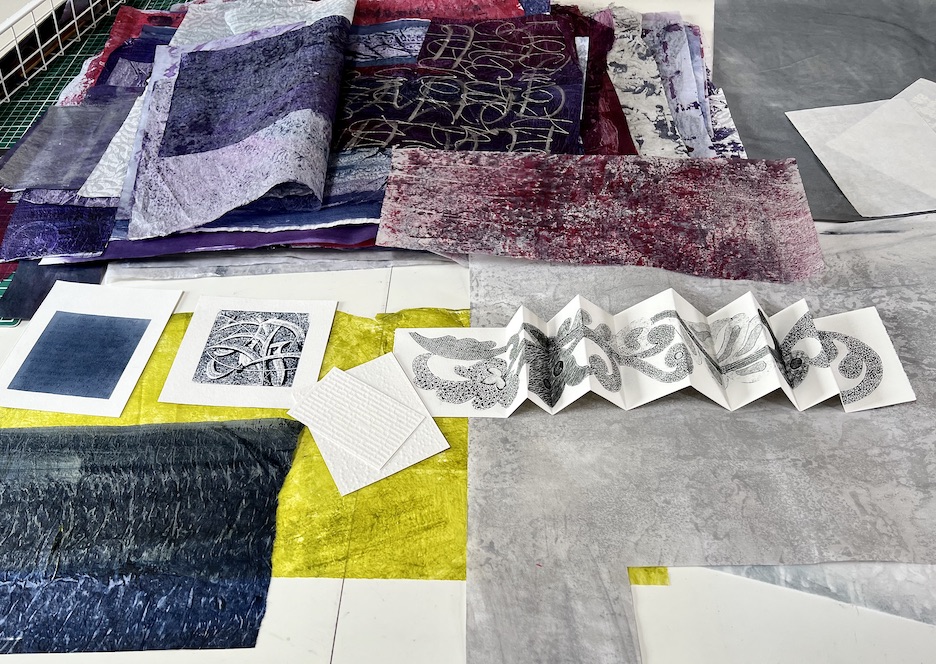
We began by sending each other a bundle of our own papers which would be incorporated into the books.
My papers for Fiona, ready to parcel up.
The received papers from Fiona spread out on my table.
The challenge was set!
For my part there followed thinking, research through my notebooks and allowing my mind to wander over ideas.
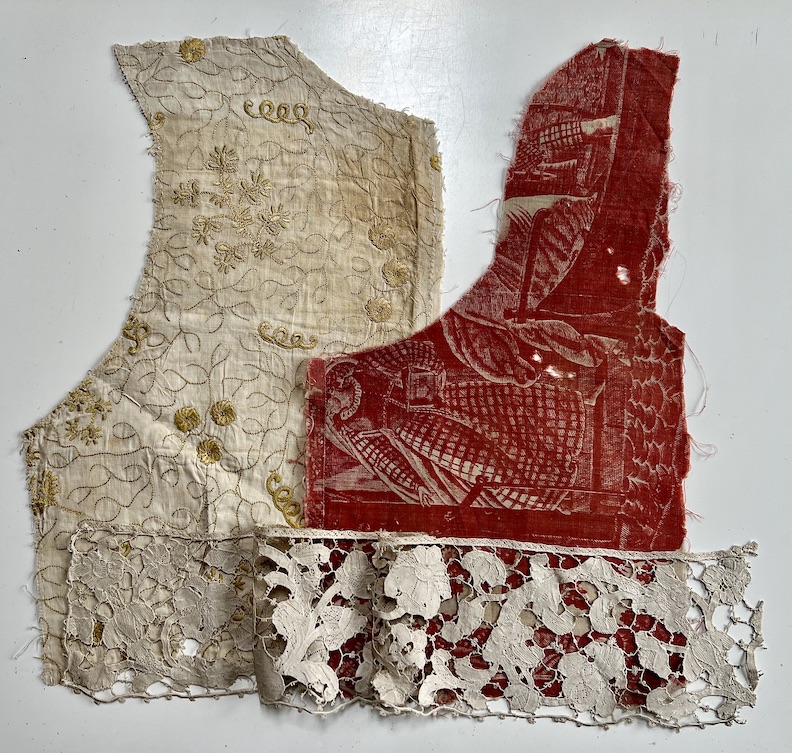
Does a shape define a thing? Some, rather than many, of my antique textile fragments are of a shape that tells of its past purpose. Lace is long and thin so that it can be used as trimmings, whereas bodices have curved edges for necks and arms. I decided to use these as my design sources and respond to them for my books.
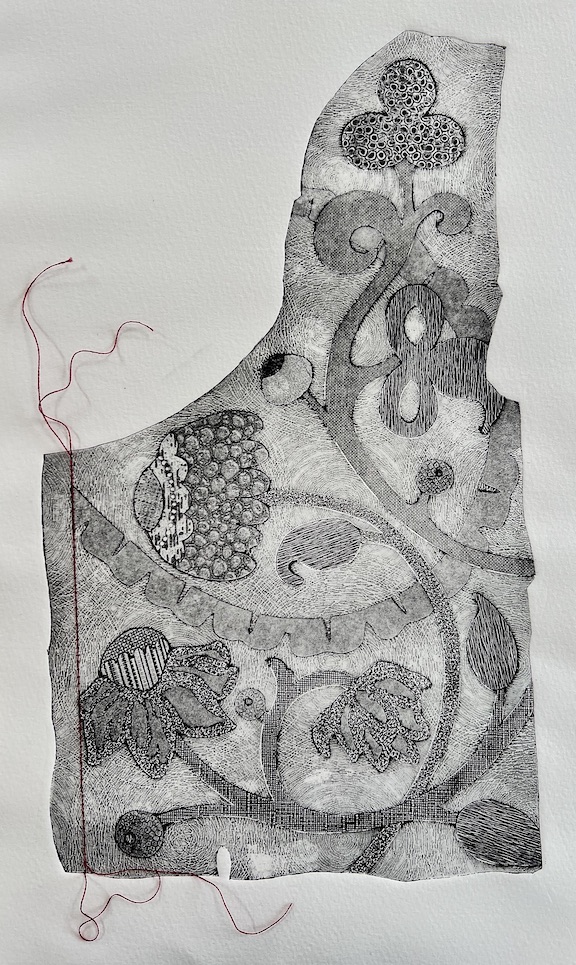
Two plates were made, here the bodice one printed
and here the cut out printing plate of lace.
To me, an important part was forward planning, an overview of the whole, a need to think about the parcel of papers, how to use them, stretch the resources throughout the series of books, consider the properties of each paper, several of which I had not used before.
I just got down to it!
Fiona had suggested that whilst we would be blogging about the project we didn’t want the other to have full knowledge of the book that they were yet to receive, so that we should only provide ‘teasers’ and then on receipt, the full reveal. Brilliant!
For me, there followed many sessions of moving the papers around, trying to work out their properties, I hadn’t worked with any of the papers before, they got shuffled around, placed into sections and constantly rearranged.
My first book evolved from the bodices and lace that I had begun with, it was a way of easing me into the practical part of the collaboration. A printing plate was designed and made inspired by the lace and the way that it was folded.
Choices had to be made for the supporting papers.
Here is almost the last stage of the covers being glued to the print.
And two teasers!
Text and print
Appliqué using Fiona’s braille paper as a printing plate onto some of her fine paper and my painted tissue paper.
It seems to me that it is important to remain true to my ideas and to produce pieces with integrity and not to create work to please the other, but to use the collaboration to extend my practice, to explore different materials and challenges.







 Annwyn Dean